
School of Psychology - Georgia Institute of Technology
(as of October, 2025)
Individuals with disabilities may face steep hurdles to education, especially in STEM fields. One of the many barriers is the inaccessibility of teaching materials, such as syllabi, exams, lecture slides, readings, assignments, and homework. Such documents come in a variety of file formats (e.g., pptx, pdf, html, docs), which themselves can contain accessibility challenges; this issue is compounded by the addition of inaccessible charts, graphs, videos, pictures, diagrams, maps, simulations, etc. A lack of both knowledge and tools for the educational content creators (i.e., instructors) means course materials are often inaccessible and of diminished utility for learners with disabilities. Higher education, as a whole, cannot cope with the widespread scale of this issue, including gaps in knowledge, limited staff, and the potentially unfathomable cost of remediating all of the accessibility issues posed by these artifacts.
Georgia Tech's AccessCORPS organization
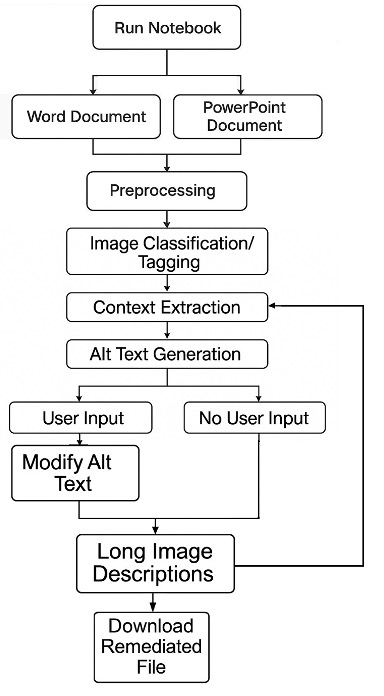 has been created to assist in making teacher-created materials more accessible. To aid the human-powered remediation process, we have created an AI-supported human-in-the-loop tool, Automated LLM-Assisted Document Descriptions for INclusion (ALADDIN). ALADDIN helps to streamline image classification and generation of alt text. ALADDIN takes a Word or PowerPoint file, looks at each image, classifies the image type, and then uses generative AI to create suitable and context-aware alt text for each image. The tagging step identifies images as: Graph, Chart, Map, Diagram, Table, Infographic, Illustration, Photograph, Text, Screenshot, 3D Model, Equation, and Other. This categorization is used to determine which code "pipeline" to use to generate the description for that image.
A key point to make here is that, at least at the present time, we cannot simply rely on an all-purpose AI engine (e.g., ChatGPT or Copilot) to create effective descriptions of images that are used in educational contexts. We need to go beyond the generic "one size fits all" AI, and leverage a variety of analysis methods and tools, and consider context as a critical element in the process.
To read more about ALADDIN, check out this paper at the ACM ASSETS 2025 conference:
Automated, Context-Aware Alt Text Generation for Educational Documents Using Large Language Models, by Disha Baglodi, Bella Martincic, Norah Sinclair, and Bruce N. Walker. ACM ASSETS Conference 2025. PDF of the paper
We also have demo videos and other materials below to help you get a better sense of how ALADDIN works, both as runnable code in a Google Collab, and as a stand-alone web service, where one can upload a file for remediation.
Contact: